
Asteroid Mining
Asteroid mining is the exploitation of raw materials from asteroids and other minor planets, including near-Earth objects.
Minerals can be mined from an asteroid or spent comet then used in space for construction materials or taken back to Earth.
These include gold, iridium, silver, osmium, palladium, platinum, rhenium, rhodium, ruthenium and tungsten for transport back to Earth; iron, cobalt, manganese, molybdenum, nickel, aluminium, and titanium for construction.
Due to the high launch and transportation costs of spaceflight, inaccurate identification of asteroids suitable for mining, and in-situ ore extraction challenges, terrestrial mining remains the only means of raw mineral acquisition today. If space program funding, either public or private, dramatically increases, this situation is likely to change in the future as resources on Earth are becoming increasingly scarce and the full potentials of asteroid mining—and space exploration in general—are researched in greater detail.[1]:47f However, it is yet uncertain whether asteroid mining will develop to attain the volume and composition needed in due time to fully compensate for dwindling terrestrial reserves.[2][3][4]
According to the Asterank database, the following asteroids are considered the best targets for mining if maximum cost-effectiveness is to be achieved:
Asteroid | Est. Value (US$) | Est. Profit (US$) | Δv (km/s) | Composition |
|---|---|---|---|---|
95 billion | 35 billion | 4.663 | Nickel, iron, cobalt, water, nitrogen, hydrogen, ammonia | |
14 billion | 4 billion | 4.888 | Nickel, iron, cobalt | |
5 billion | 1 billion | 4.986 | Nickel, iron, cobalt | |
84 billion | 22 billion | 5.162 | Nickel, iron, cobalt | |
8 billion | 2 billion | 5.187 | Platinum, nickel, iron, cobalt | |
5570 billion | 1250 billion | 5.439 | Magnesium silicate, aluminum, iron silicate | |
147 billion | 30 billion | 5.636 | Magnesium silicate, aluminum, iron silicate | |
84 billion | 17 billion | 5.647 | Nickel, iron, cobalt | |
4 billion | 0.6 billion | 5.880 | Nickel, iron, cobalt | |
0.3 billion | 0.06 billion | 5.894 | Nickel, iron, cobalt |
NASA | OSIRIS-REx Investigates Asteroid Bennu
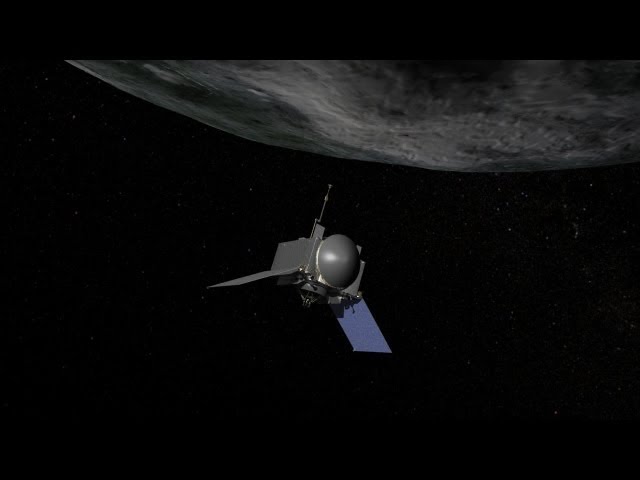
OSIRIS-REx will visit a Near Earth asteroid called Bennu and return with samples that may hold clues to the origins of the solar system and perhaps life itself. It will also investigate the asteroid’s chance of impacting Earth in 2182. For the mission, NASA has selected the team led by Principal Investigator Dr. Dante Lauretta from the University of Arizona.
NASA GSFC will manage the mission and Lockheed Martin Space Systems will build the spacecraft. Arizona State University will supply the OTES instrument; NASA GSFC will supply the OVIRS instrument; the Canadian Space Agency will supply the OLA instrument; the University of Arizona will supply the OCAMS camera suite; Harvard/MIT will supply the REXIS instrument; and Flight Dynamics will supply the KinetX instrument.
This video is public domain and can be downloaded at: http://svs.gsfc.nasa.gov/goto?10793
Like our videos? Subscribe to NASA’s Goddard Shorts HD podcast: http://svs.gsfc.nasa.gov/vis/iTunes/f… Or find NASA Goddard Space Flight Center on facebook: http://www.facebook.com/NASA.GSFC Or find us on Twitter: http://twitter.com/NASAGoddard